AI History Battle
An in-person game that teaches the history of AI and statistics by letting students be it. Each student taps an NFC sticker to claim a historical figure — Bayes to Turing to the researchers publishing today — then battles classmates by tapping their stickers. Every outcome is decided by real history: whose methods genuinely apply to the drawn problem, explained after every battle.
Play the Gauntlet →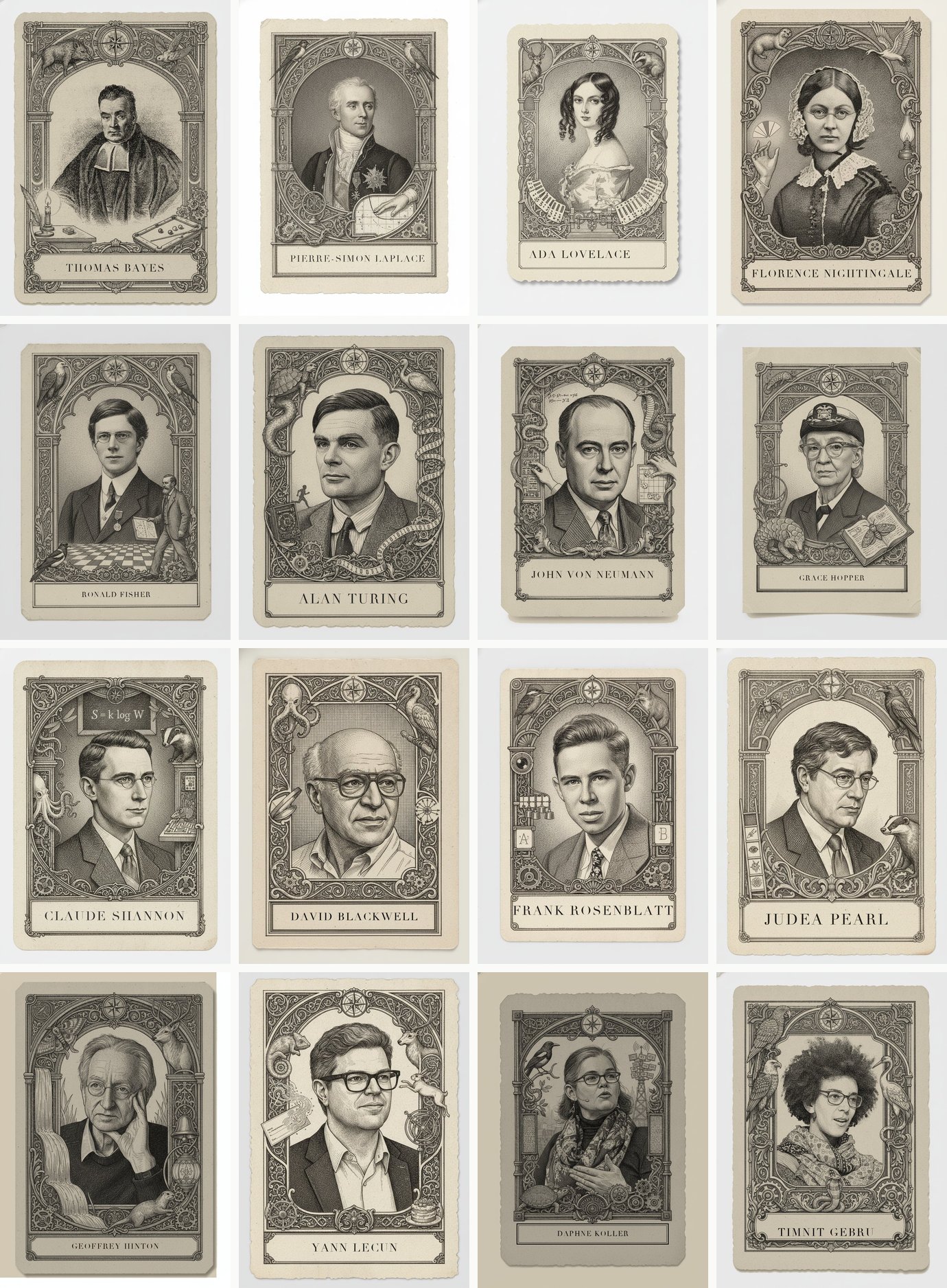
The short version
AI History Battle is a multi-day event game for ~100 graduate students. Every student carries an NFC sticker linked to a pseudonymous persona: a famous statistician, mathematician, or AI researcher. Tapping another player's sticker creates a battle — the system draws a problem the pair hasn't fought over, scores both personas from a precomputed persona-by-problem matrix grounded in real intellectual history, and the tapper's phone shows the result with a historical justification. Students learn the field's history through play: who solved what, whose methods reach furthest, and why a 1920s statistician can still beat a deep-learning pioneer on the right problem.
The long version
Pedagogy
Graduate ML curricula teach methods; they rarely teach lineage. The game makes lineage playable. Each of the 300 problems spans 18 categories of the field, and each battle result carries an 85–160 word explanation of why the winning figure's methods genuinely apply — so every tap is a micro-lesson, and losing is as instructive as winning. Personas are pseudonymous, which lowers social stakes: the leaderboard knows Fisher, not the student.
The cast and the content matrix
- 151 personas spanning three centuries — deep historical statisticians through currently publishing researchers, with era coverage guaranteeing the old guard their winning problems.
- 300 problems across 18 categories, with each persona assigned a ~100-problem list; all 11,325 persona pairs verified to share at least 15 problems (median ~32).
- 15,170 pre-scored cells, each with a written historical justification, validated for exact problem-carrier match, score spread, and explanation length.
- Event simulation at full scale — 2,500 battles across 100 students — verified healthy dynamics: every persona wins somewhere, no one is stuck, repeat matchups stay near 21%.
- 152 stylized portraits, one per figure.
The mechanic
- Each NFC sticker stores one static URL. First tap claims the persona, protected by a student-set PIN. A tap on another player's sticker is intent — no confirmation step; the battle resolves immediately.
- Problems are drawn without replacement per pair, so rematches always land on fresh ground. Only the tapper's phone shows the result; a reverse tap is a new, independent battle.
- A live leaderboard and a live interaction graph show the room's play as it happens.
The system
Node/Express on Google Cloud Run with Cloud SQL (Postgres) and Secret Manager; an admin console handles coin management, battle voiding, event freeze/unfreeze, and an NFC write desk used to program all 152 stickers from a phone via Web NFC. The full content layer — roster, problems, score matrix, biographies, portraits — was generated through an LLM pipeline with validation gates and an owner review pass at each stage.
Status
Built summer 2026; content pipeline complete and validated; all 152 stickers written; debuting at the UC Berkeley MIDS immersion, August 2026.